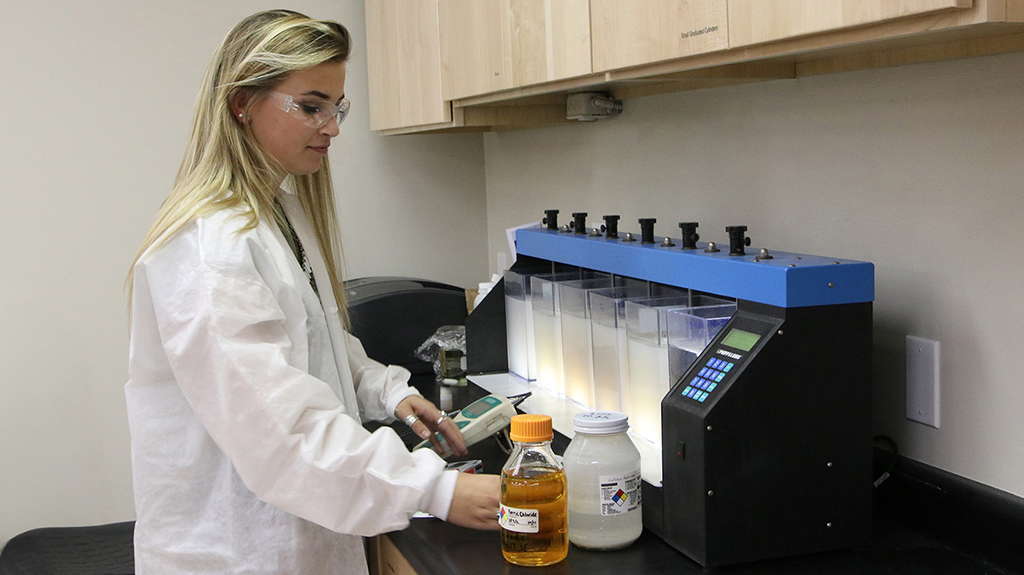
WesTech's physchem lab is a hub of activity where water samples undergo rigorous testing to determine the most effective treatment methods for solid-liquid separation. Our physchem lab’s focus is not just on identifying the contaminants, but on designing practical, scalable solutions for their removal.
Initial Characterization: Setting the Baseline
Every water sample that arrives at the lab undergoes an initial characterization. This involves measuring several key parameters that provide a baseline understanding of the water's condition. These parameters include:
pH: A measure of acidity or alkalinity, which can greatly influence chemical reactions.
Temperature: Affects reaction rates and biological activity.
Total Suspended Solids (TSS): The amount of solid material suspended in the water.
Total Dissolved Solids (TDS): The amount of dissolved substances in the water.
Conductivity: A measure of the water's ability to conduct electricity, often related to the concentration of ions. This is an indirect measure of TDS.
Specific Metal Concentrations: If particular metals are of concern, their initial concentrations are measured.
Testing and Simulation of Processes
With the initial characterization complete, the lab moves on to simulate various treatment processes. These tests include:
Sedimentation Tests: These tests assess how quickly solids settle in the water under gravity conditions. This data is used to size and design clarifiers and thickeners.
Jar Testing: The lab uses a multi-stirrer device with multiple jars, allowing them to simultaneously test different dosages of coagulants and flocculants. By comparing the results in each jar, they can identify the optimal chemical additions for efficient flocculation. Other chemical additions may be studied in jar testing for the removal of various contaminants from the water.
Ballasted Flocculation: For water with challenging particles that settle slowly, ballasted flocculation may be used. This involves adding very fine sand to the floc to increase its weight and settling velocity. The lab tests different ballast dosages with different coagulant and flocculant dosages to find the most effective combination.
Cold Lime Softening: This process is used to remove hardness-causing ions like calcium and magnesium. The lab conducts jar tests with lime to determine the optimal dosage for precipitation and removal of these ions.
Filtration Tests: A variety of filtration methods are tested, including:
Ultrafiltration (UF): A membrane filtration technique that removes very fine particles and microorganisms.
Disc Filters: Another type of membrane filtration that uses rotating discs to remove solids.
Vacuum Drum Filters and Filter Presses: Tests simulate dewatering processes.
Particle Size Distribution: This analysis determines the range of sizes of the solids in the water, which is crucial for selecting appropriate separation methods.
Rheology Testing: For applications involving thick slurries, rheology testing is used to measure the flow characteristics of the material, aiding in the design of paste thickeners.
Precision Testing, Proven Results
Through this rigorous testing protocol, WesTech's physchem lab transforms raw water samples into actionable engineering data. Each test, from initial characterization to rheology analysis, builds a more complete picture that enables our process engineers to design treatment systems with confidence. The result? Solutions that work as intended in the field because they've already been proven in the lab.