What AI Data Centers Need to Know About Water Quality and Treatment

As AI-driven workloads surge and rack densities rise, the data center conversation has shifted. Power used to dominate the planning process, but now water is joining (and in some regions eclipsing) energy as a critical constraint. For operators, engineers, and developers moving quickly to expand AI capacity, one question keeps resurfacing:
Is your water treatment strategy built for the coming wave of phased build-outs and their cooling demand?
Below is a straightforward look at why water performance is becoming a defining factor for AI facilities and how teams can stay ahead of risk, cost, and regulatory variations while maintaining project schedules.
The Water Demand Curve Is Steepening
For evaporative cooling, cloud data centers can require large volumes of water. But AI fundamentally changes that equation.
High-density racks, accelerated training workloads, and nonstop utilization have expanded the demand on cooling systems. In many regions, a 100 MW AI campus may demand half a million gallons of water per day just to keep temperatures stable.
That kind of footprint impacts:
- Permitting timelines
- Community relationships
- Operating expenses
- Redundancy and resiliency planning
For owners and operators, the challenge isn’t just securing water – it’s ensuring every gallon is working at maximum efficiency.
Cooling Systems Now Operate as a Single, Interconnected Loop
Whether supplied by municipal sources, wells, or surface water, the quality of incoming water directly affects the level of treatment required for cooling tower performance, chiller longevity, and waste stream volumes.
The industry is increasingly treating the entire cooling loop as a single, integrated system rather than a collection of isolated components. As cooling systems scale to support larger, campus-style data center developments, once-through cooling approaches can be insufficient. This trend is driving a shift toward more conventional, engineered cooling architectures that emphasize reliability, water efficiency, and lifecycle optimization. That includes:
- Source water treatment
Ensuring raw or municipal water meets consistent quality standards so downstream components work optimally. - Side-stream filtration
Capturing solids and biological growth that increase chemical demand, degrade heat-transfer surfaces, and accelerate maintenance cycles. - Bleed recovery and reuse
Reclaiming tower blowdown and process waste to reduce freshwater intake, becoming essential in regions with tightening water restrictions.
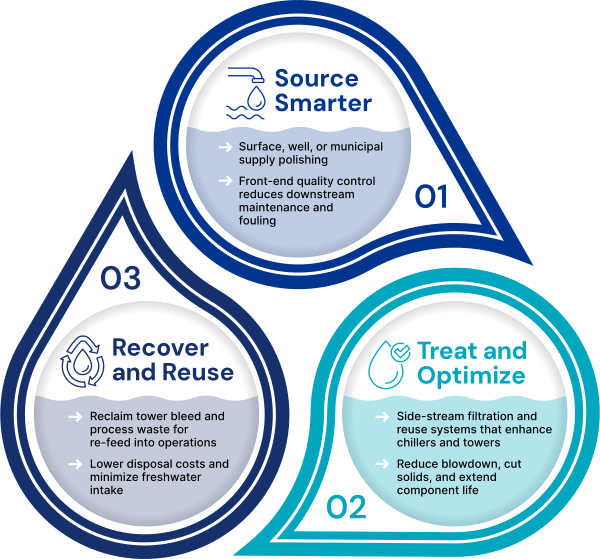
The Optimized Cooling Loop
Source Smarter
- Surface, well, or municipal supply polishing
- Front-end quality control reduces downstream maintenance and fouling
Treat and Optimize
- Side-stream filtration and reuse systems that protect chillers and towers
- Reduce blowdown, cut solids, and extend component life
Recover and Reuse
- Reclaim tower bleed and process waste for re-feed into operations
- Lower disposal costs and minimize freshwater intake
This holistic approach is quickly becoming the standard for AI and hyperscale facilities.
Why Optimization Matters More Than Ever
In AI-scale environments, even small inefficiencies are amplified. A minor fouling issue in a cooling tower can raise energy consumption, force unplanned maintenance, or increase chemical usage. Water clarity, consistency, and chemistry all directly influence uptime.
Teams leading new campus builds are finding that the most successful projects are those where:
- Water treatment is integrated early, not bolted on after the mechanical design is finalized.
- Water chemistry and solids control are aligned with cooling system design, not treated separately.
- Operational resilience is prioritized, especially in communities where water availability or public perception is sensitive.
Have questions about water quality, cooling performance, or treatment options for AI-scale workloads?
Connect with a WesTech specialist for a tailored assessment