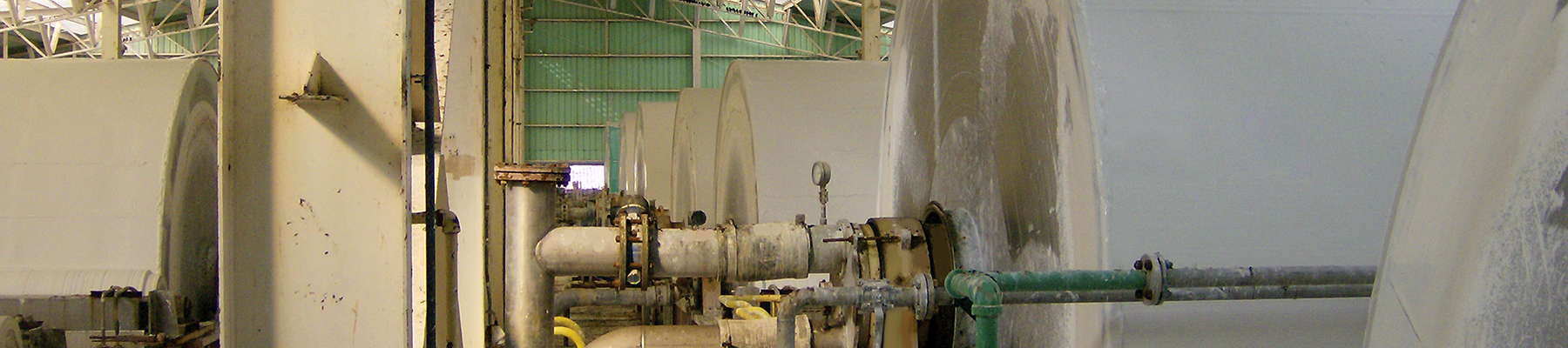
The most common process for making paper is called the Kraft or Kraft Mill process. In this process, wood chips are cooked at 150 - 165 degrees Celsius under pressure in a liquid solution containing caustic (NaOH) and sodium sulfide (Na2S) to pulp the wood.
White Liquor
The solution of caustic and sodium sulfide is referred to as “white liquor.” These chemicals, along with heat and pressure, release the lignin from the fibers in the wood. The resulting pulp is washed, screened, and sent on to bleaching and becomes the feed stock for the paper-making process.
Black Liquor
The waste from the pulping washing step (residual chemicals, lignin, organics, etc.) are removed and become what is known as “black liquor.” This black liquor is sent to multiple effect evaporators to be concentrated. From there it is burned in the recovery boiler.
The black liquor is burned in an oxygen-deficient atmosphere. This process forms a molten product consisting mostly of Na2S and sodium carbonate (Na2CO3).
Green Liquor
This molten material is referred to as “smelt.” It is sent to a tank where water is added. The resulting liquid is known as “green liquor.” From the smelt tank the stream is sent to the green liquor stabilization tank.
The green liquor also contains small amounts of suspended solids, called “dregs.” The dregs are hazardous and must be removed. This is typically done in the green liquor clarifier.
Dregs
The dregs from the green liquor clarifier are sent to a rotary vacuum filter called the “dregs filter.” Here the dregs are washed to remove residual chemicals and are dewatered prior to disposal. The liquids are recycled to the green liquor stabilization tank.
Slaker
The clarified green liquor is fed to a slaker where NaOH is formed. The grit and unreacted lime settle to the bottom where they are removed by means of a screw conveyor.
The slurry flows through a series of agitated tanks in a process known as causticising. The main products of this process are calcium carbonate (CaCO3) and NaOH. The effluent of this process is now referred to as white liquor and is pumped to the white liquor clarifier.
The overflow from this clarifier is returned to the pulp digestion process. The settled CaCO3 precipitate is known as lime mud. This slurry is washed with a combination of fresh and recycled water.
Lime Mud Washer
This wash water is sent to the lime mud washer. The overflow from this unit is sent back to the smelt tank. The underflow is dewatered on a rotary vacuum filter known as the “lime mud filter.” The dewatered solids (CaCO3) are sent to the lime kiln to be converted to burnt lime (CaO). The filtrate from these filters is returned to the lime mud mixer tank.
In this way, a very high percentage of all the chemicals used are recycled and there is much less impact on the environment from waste disposal.