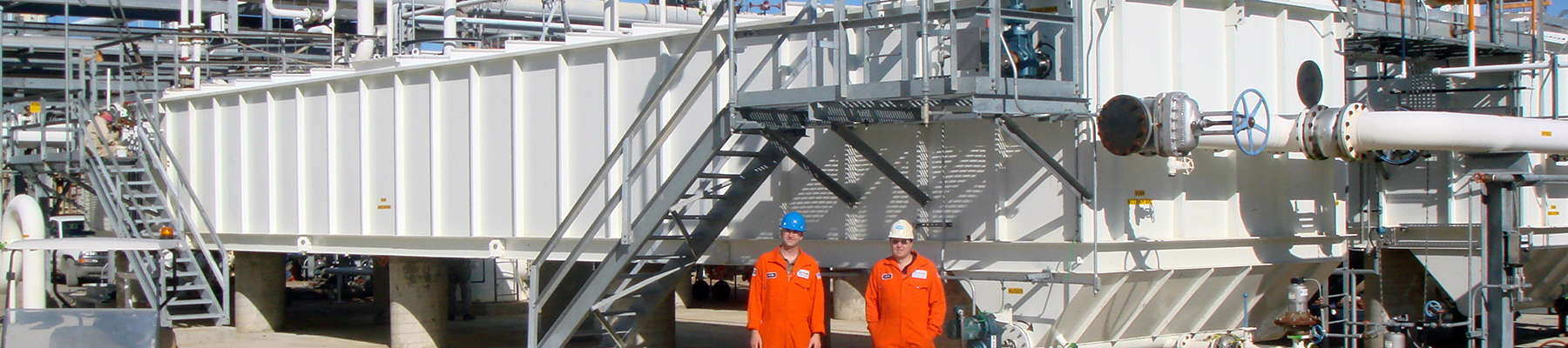
The other common way to recover bitumen from oil sands is through open pit mining of deposits near the surface. This process is similar to strip mining for coal or other minerals.
Mining shovels remove the oil sand and load it into large trucks. The trucks carry the oil sands to mobile crushers. The crushed material is then stockpiled for the next step.
Slurry
The oil sands broken up in these crushers are then fed to rotary breakers with the addition of hot water to remove rocks and other debris. The resulting slurry is pumped through a pipeline and chemicals are added as required. The slurry is sent to a primary separator where it is classified into three distinct cuts —the overflow, the middle means, and the underflow.
The middle means are sent to flotation units where the floating material is recovered and returned to the head of the primary separator. The underflow from the flotation units is combined with the primary separator underflow and sent to a trash screen. The oversized material from the screen is washed and is returned to the mine via pipeline to fill in mined-out areas. The undersized material is sent to a further bank of flotation units. Floated material off the secondary flotation units is also recovered to the head of the primary separator while the underflow is sent to the tailings thickener.
Bitumen
The overflow from the primary separator is sent for processing via steam heating of the bitumen. Bitumen is deficient in hydrogen and must be upgraded to synthetic crude oil specification in order to be acceptable feedstock for refineries. This is done by the addition of hydrogen or the rejection of carbon, or both. Upgrading uses natural gas as a source of heat and steam for processing and also as a source of hydrogen. Other hydrocarbons, such as naphtha, may also be used for upgrading.
In the tailings thickeners, the suspended solids are settled to a sludge that is sent to a horizontal vacuum belt filter for dewatering. The filtrate from the horizontal belt filter is returned to the head thickener for reprocessing. The dried cake from the horizontal belt filter is sent to tailings piles or landfills for disposal.
Overflow
The overflow of the tailings thickener is water that is recovered for recycling back into the circuit. This is not solely due to restrictions on water usage. It is therefore critical that treatment processes involving water recovery in reuse are employed in this application. The combination of tailings thickener(s) and vacuum dewatering equipment results in maximum water recovery.